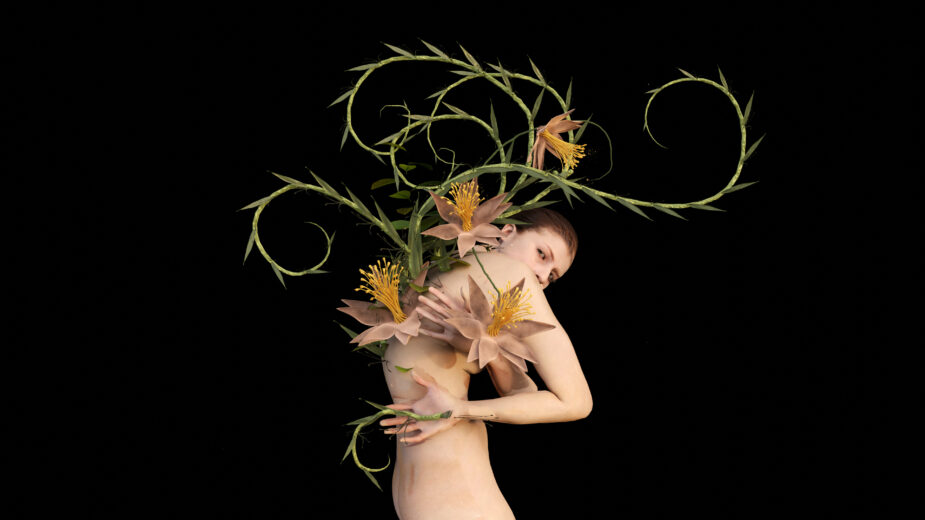
In September, Johanna Nuutinen premieres Élixir de Mer, her fourth work of the series exploring senses and our sensory experiences. This time she delves into the sense of smell, and explores its physical effects through dance, sound, and space. In her previous choreographies, she has examined the senses of touch, sight, and hearing. Premiere at Dance House Helsinki, September 25.
TEXT Maria Säkö | This article was originally published in Finnish Circus & Dance in Focus magazine 2025.
Choreographer Johanna Nuutinen‘s works reach from the smallest pixels within humanity to the newest scientific and technological innovations. Her works are a blend of the urban environment and archaisms, butoh dance influences, Finnish nature, and elements of surrealist film. Where softness and sensitivity meet the stern and austere.
Choreographer Johanna Nuutinen’s Six Steps
Nuutinen set off on her path from professional dancer to choreographer about ten years ago. From the very beginning, she burst out of the dancer pigeonhole onto the broader field of dance as a choreographer, with works that examined the modern person with a rare complexity.
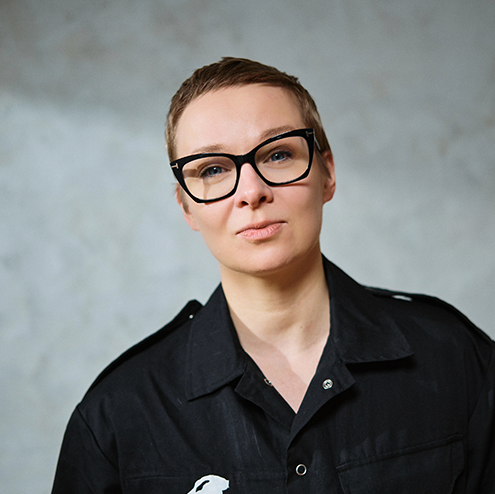
Nuutinen has made works with artistic teams she assembled herself as well as for companies such as Skånes Dansteater, Finnish National Ballet, West Australian Ballet, and Tero Saarinen Company. As a choreographer, she has toured in Europe and Asia and sought training in Japan, among other places. Her creations also include several dance films.
Her combination of sensitivity and honesty, the latest cutting-edge technology, and a strong presence, doesn’t exactly sound like the easiest thing to achieve.
What are the steps she takes to do it? In this article, we follow Nuutinen’s works through six steps, from the rehearsal studio to conversation sessions with researchers.
Step one: Precision
We begin with what engages the viewer’s attention in Johanna Nuutinen’s piece Skin Hunger. It’s the surgical precision that transcends movement. And the sound. And the light.
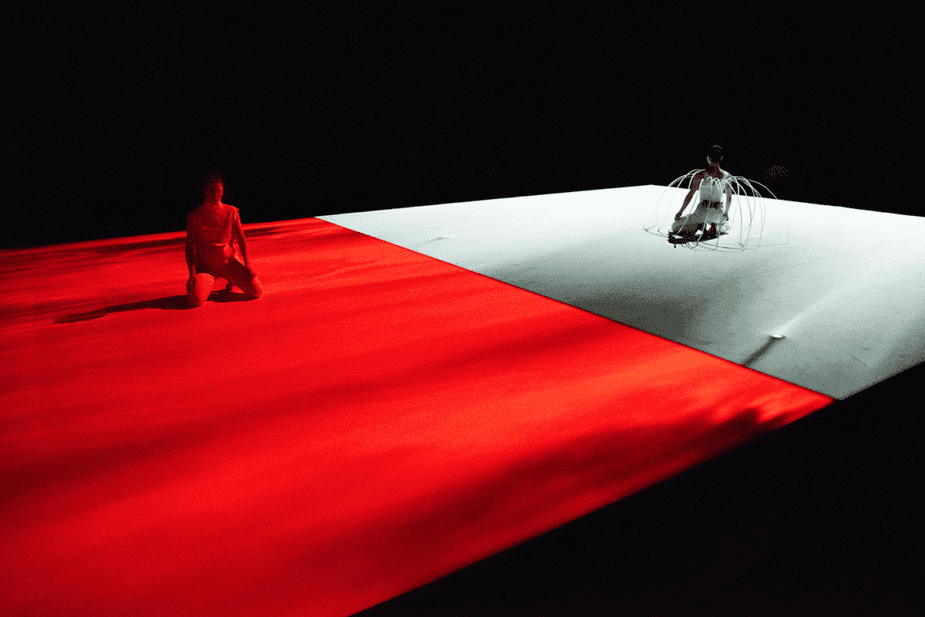
And various materials that the audience can almost feel on their fingertips, from the soft to the clammy, from the spiky to the sticky. In all these things there is a dazzling precision, but the piece achieves something even more. It slides into physical imagination.
Nuutinen’s works cut deep into internal physical and psychological states. Whether through the sense of sight as in Opia, her previous work in the senses series, or the sense of hearing in her work Hz. Or the sense of touch, as in Skin Hunger.
“I’m inspired by the tiniest pixels of the state of being and depth of existence. I’m interested in how the performers negotiate with their journey through a piece. And our relationship with each other and with ourselves over the course of the creation process,” Nuutinen says.
“Nowadays, I communicate already during the recruitment stage about the level of precision I wish for during the work.”
Step two: Self-Reflection
In order to be able to deal with and direct the intention of the actions happening on the stage, you must first be aware of it.
“I think this requires a capacity for self-reflection. It’s wonderful to be able to explore the nuances of movement and its directions with a higher resolution. In the same way as an actor explores the intention and finer rhythms of the verbal material,” Nuutinen describes.
But she doesn’t use an artist’s wound as her launching point. Each artist can bring up their wounds if they want to, but she doesn’t want to delve into them herself.
When it comes to a stage work, Nuutinen asks what we bring of ourselves to the stage. “And how does all of that unconscious material become a part of the performance?”
Step three: Frames
Ideally, Nuutinen first gives a morning class that includes physical exercises focused on creating movement material.
“That’s how I introduce the world of my own embodied imagination and I hope to be able to meet with the performer there.”
The best moments for her as a choreographer are when she is able, together with her dancers, to produce material through the process of dancing and dialogue. Eventually, they define the frame of the scenes and the characters together.
Nuutinen says that it was specifically within the clear and detailed frames of characters, tasks and scenes that she once found the space for creativity as a dancer.
The frames are always there—it’s just a matter of whether we recognize them, and how.
“Working on a role and subtly embodying different characters was a big part of my own dancing career. While observing performances that aim to create a sense of ‘role-free’ individuals, I’ve had to consider whether we are ever truly free of roles and how we portray this state on the stage.”
Step four: The Senses
“Precise and framed” is often conceived of as a cold or at the very least distant impression.
When watching Nuutinen’s works, one can throw those preconceptions out the window, for the works are so deeply rooted in an honest experience.
It has created a need for me to meet the other face to face. I want to form my truth and my reality with all of my senses present at the moment of meeting.”
The through line of Skin Hunger is the importance of the role skin contact plays in the growth and development of humans, and living things in general.
The name of the piece comes from the fact that Nuutinen is concretely aware of the calming effect of skin contact. “I want to build a place for others where, in the end, we can calm down together.”
But Nuutinen’s aspiration is not inconsistent with the fact that Skin Hunger doesn’t offer us any obvious gentleness.
There are many moments of nearly touching in the piece, where an attempt to caress might be made, but also situations that could escalate into a fight.
“Violence also has to be dealt with, because it’s a part of our lives as living creatures. When I was creating the piece, I thought about how that could be subtly brought into the work. How could it be included without talking about it or showing it explicitly?”
In dealing with the senses, Nuutinen is interested in polar extremes, and everything in between.
Exploring the senses in works of art has increased Nuutinen’s understanding of the fact that we humans build our reality through our sensory perceptions – we live at the mercy of our senses.
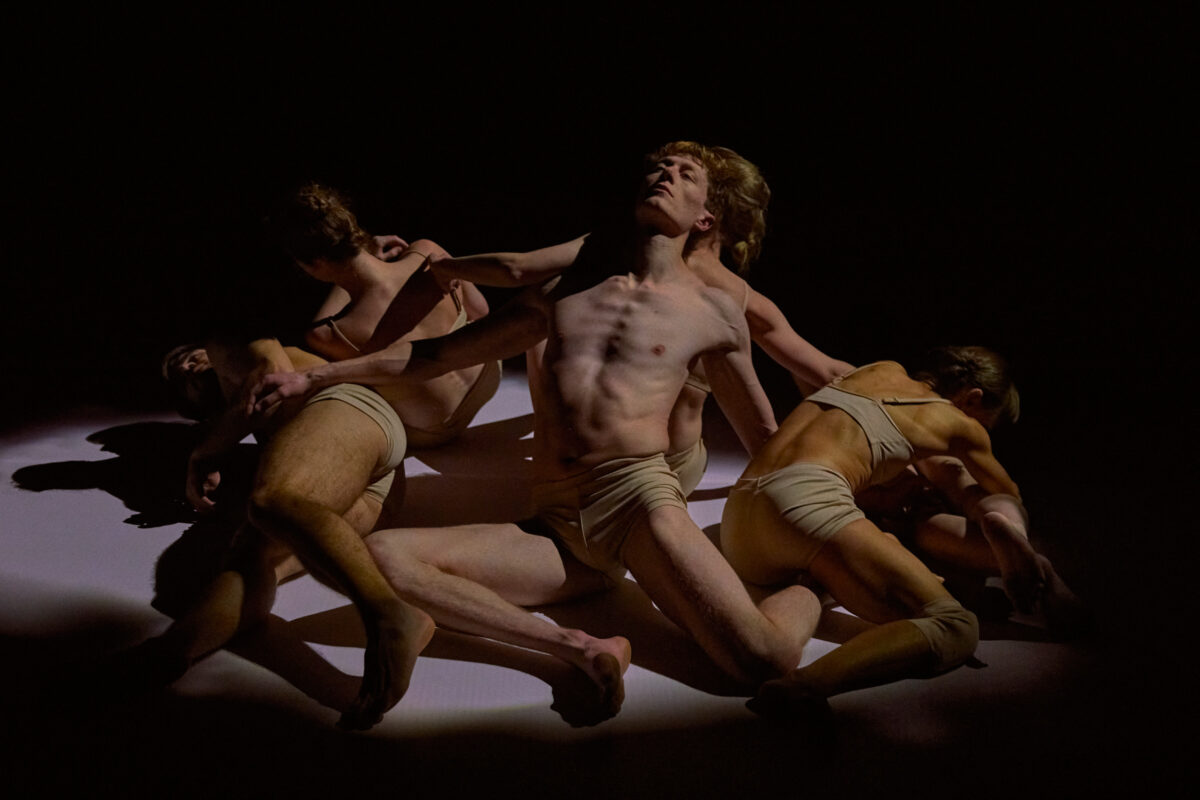
“It has created a need for me to meet the other face to face. I want to form my truth and my reality with all of my senses present at the moment of meeting.”
Step five: Technology
Nuutinen has an interest in the person in the most holistic sense, and thus also in the capacity of the newest technologies for aiding in understanding the person.
“If new technologies can deepen a theme and the viewer’s experience, then I use them, but otherwise I don’t,” Nuutinen emphasizes.
In Skin Hunger, it was important for the artistic team to get close to the viewer in a large theater space, so the sound was brought close to the audience by means of headphones.
Nuutinen has the expertise of her collaborators to thank for the relationship to advanced technologies in her dance works.
For the piece Skin Hunger, sound artist Tuomas Norvio suggested a binaural soundscape. The performers wear mics in both ears, and the audience can hear the sounds of the space coming from the same directions as the performers are hearing them.
Binaural sound design thus gives the viewer the illusion of being in the performer’s place. Since all the pre-recorded music is delivered only through the headphones, the performers work in silence and must find the density of the dance within themselves.
Step six: Diversity
The collaborators that Nuutinen has assembled around her are currently made up of artists and experts from many cultural backgrounds.
“It has been important to consider the contents of the stage work in collaboration with individuals who can share their perspectives from outside our Nordic circle of experience.”
Nuutinen’s works have a powerful zeitgeist.
Last spring, during the presentation of her work Zero-Zero at the Dance House Helsinki, talks with researchers from various fields were held after the performances.
Nuutinen’s works have a powerful zeitgeist. This makes them excellent points of reflection for the discussions currently taking place across several fields of research, such as those concerning encounters.
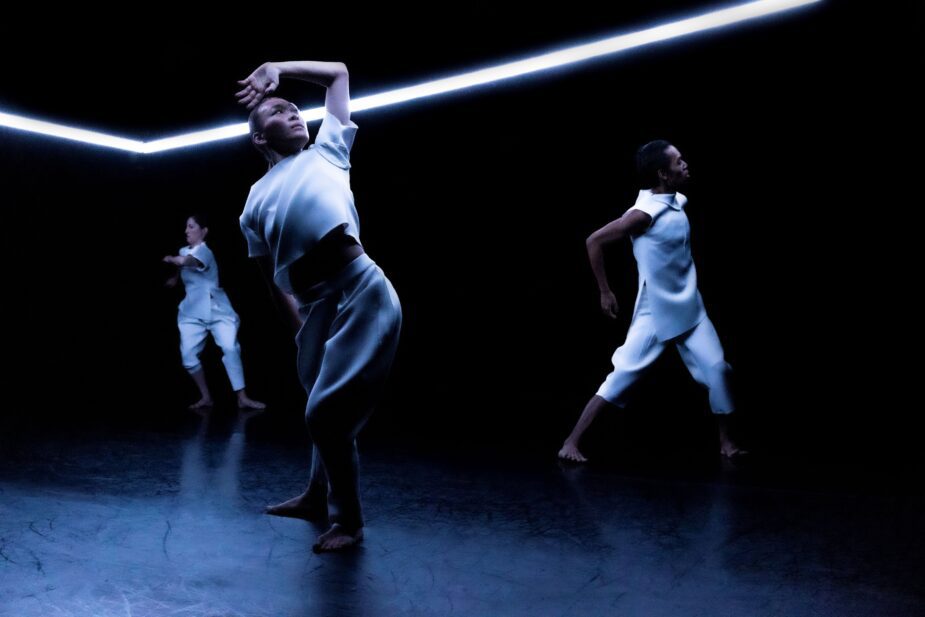
Precision, frames, long-term thinking, and curiosity about new things, such as questions in neuroscience, have led her to comment on the spirit of the time and the diversity of the world.
From these steps a cycle is born where one can reach from the tiniest pixels to the greatest scientific paradoxes––and they in turn bring one back to self-examination.
We have walked with Nuutinen through one cycle. It’s time to let go, but in the end we still have to ask her how she hopes her works will affect her audiences.
“I hope my works will broaden viewers’ understanding of themselves, and I want to awaken them to think about how layers formed by sensory experiences live within them.”