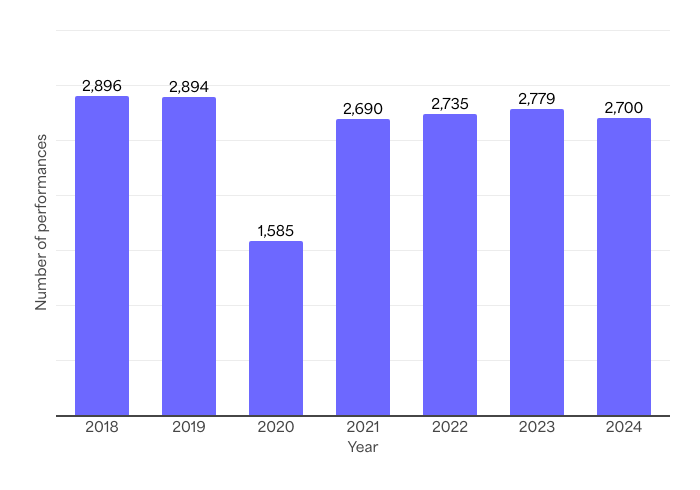
The dance statistics published in June show that the number of performances and attendance rates have not reached their pre-covid levels. Cutting from a labour-intensive sector will result in unemployment.
The dance sector in Finland is becoming divided. There are those with a diversifying funding base and gradually increasing numbers of performances and audiences. Then there are others who do not receive state subsidies and who have seen their performance and audience numbers decline compared to the previous year.
The majority of dance performances and almost 90% of audiences were generated by the 40 companies receiving state funding. For dance companies and individual choreographers working without state funding – of which there are more than 60 – the number of performances and, consequently, the total number of viewers remained low. The number of these companies has been in decline for several years now.
Dance companies and production centers staged approximately 2 700 performances in 2024 and these performances attracted a total of 363 500 spectators. Beside Finland, Finnish dance companies performed in countries across Europe as well as in the United States, Colombia and South Africa.
Funding structures support continuity
Some of the groups receiving Taike’s operating grants have succeeded in developing their income generation.
Approximately half of the funding for these groups comes from government subsidies, and the other half is obtained from ticket sales, performance fees, other income, and by applying for other grants from both the private and public sectors.
The government supported dance arts with a total of €10.7 million in 2024.
Cutting down on personnel slows down development
Producing dance performances is labor-intensive. Nearly two-thirds of dance companies’ expenses are personnel costs, even though salaries in the sector are low. When other operating expenses, especially for independent groups, are often cut to the point where one can talk about shoestring budgets, there is no other option but to reduce the number of people – dancers, other artists and designers, producers.
In this case, there is a risk that the conditions for vitality and growth will not be met, as has been the case with many dance companies and individual choreographers working without state support.