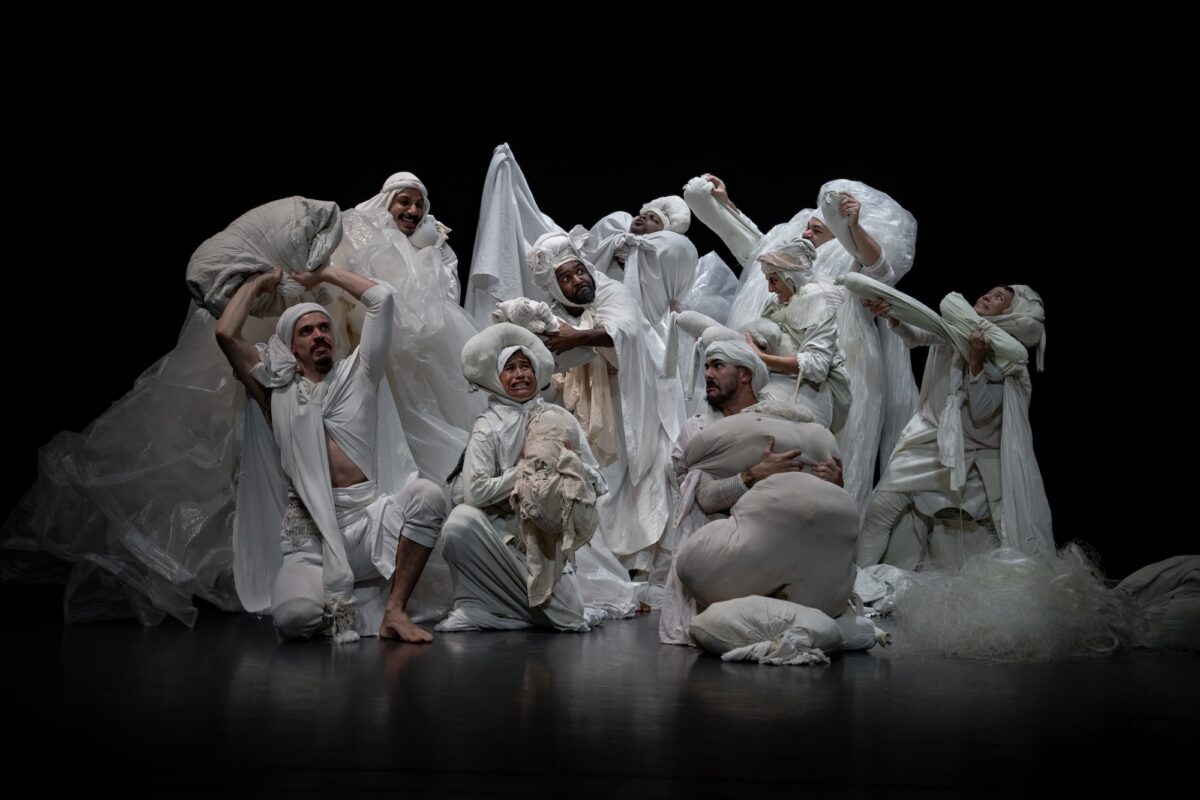
Hailed as "Brazil's miraculous choreographer", Dance House Helsinki’s international guest performance series presents the works of Lia Rodrigues in Finland for the first time.
Over a career spanning more than 40 years, Rodrigues has become one of Brazil’s most influential contemporary choreographers, captivating audiences around the world with socially engaged works. Her latest piece, Borda, is a timely and sensuous exploration of borders — how they are formed, how they shift, and how they constantly transform.
In Portuguese the word ‘borda’ is derived from the verb ‘bordar’, embroider, which means to enrich, to decorate, to enhance, to elaborate. It stands next to the other meaning of this word: border, fringe, boundary, verge, margin, threshold, limit, barrier, frontier. That what separates.
There are geographic and political borders, sometimes represented by walls, barbed wire, hedges, checkpoints, gates. Sometimes they suppose a hierarchy. Sometimes areas of oppositions are created: hospitality and hostility, freedom and domination, what is considered native and what is foreign, inferior and superior. It is the home of the otherness.
The work asks how can we work from a reality intertwined with visible and invisible lines, that mark the boundaries between fear and hope, between noise and quietness, flood and fire. How can we bring with us the land of our visions, desires, memories, futures? Perhaps by patiently and laboriously weaving together a porous place of fluid alterity, an embroidery where margins move, float and dance.
Nine dancers move through a landscape partially dissolved into fabrics, plastics, and recycled materials. Together they form sculptural shapes made from remnants of earlier works; fragments of stories are given new life. Rich in colour and emotional force, the performance invites us to open borders and imagine another kind of world: one where coming together triumphs over separation, acceptance over rejection, and open doors over closed ones.
Rodrigues is known for her inclusive working methods and her long-term collaboration with local communities in Brazil. Her works give space to voices that too often remain unheard. Fifteen years ago, she founded the arts centre Centro de Artes da Maré in the Maré favela of Rio de Janeiro together with a local NGO. In recognition of this work, she was awarded an honorary doctorate by the University of the Arts Helsinki in 2024. Through her uncompromising vision, Rodrigues demonstrates that dance is more than movement: it is an act of change, a way of opening worlds, and an invitation to solidarity.
Danced and created in collaboration with: Leonardo Nunes, Valentina Fittipaldi, Andrey da Silva, David Abreu, Raquel Alexandre, Daline Ribeiro, João Alves, Cayo Almeida, Vitor de Abreu
Creation assistant: Amalia Lima
Dramaturgy: Silvia Soter
Artistic collaboration and images: Sammi Landweer
Lighting design: Nicolas Boudier
Stage management and lighting: Magali Foubert and Baptistine Méral
Soundtrack : Miguel Bevilacqua (from excerpts of a recording made in 1938 in northern Brazil by the Folklore Research Mission conceived by writer and intellectual Mario de Andrade and excerpts from the public domain music “Amor Amor Amor”, part of the repertoire of “Cavalo Marinho”, a Brazilian dance performed by Luiz Paixão. )
Mixing and mastering: Ronaldo Gonçalves
Production/ manager: Colette de Turville
Assistant production: Astrid Toledo
Production and manager Brazil: Gabi Gonçalves/ Corpo Rastreado
Secretary/administration: Gloria Laureano
Logistical support Centro de Artes da Maré: Sendy Silva
Teachers: Amalia Lima, Leonardo Nunes, Valentina Fittipaldi, Andrey Silva
Costumes: Lia Rodrigues Companhia de Danças
Seamstress: Antonia Jardilino De Paiva
Acknowledgements: Thérèse Barbanel, Corpo Rastreado, Inês Assumpção, Luiz Assumpção, Diana Nassif, Centro de Artes da Maré team, Jacques Segueilla.
Dedicated to Max Nassif Earp
Production: Lia Rodrigues Companhia de Danças
Co-production: Kunstenfestivaldesarts – Brussels / Maison de la danse / Pôle européen de création (with the support of the Biennale de Lyon) / Chaillot – Théâtre National de la Danse – Paris / Le CENTQUATRE – Paris / Festival d’Automne à Paris / Wiener Festwochen – Vienna / La Bâtie – Festival de Genève – Comédie de Genève / Romaeuropa – Rome / PACT Zollverein – Essen / One Dance Festival – Plovdiv / Theater Freiburg / Muffatwerk – Munich / Passages Transfestival – Metz / Festival Perspectives – Saarbrücken / Le Parvis, scène nationale Tarbes-Pyrénées / Tanz im August / HAU Hebbel am Ufer – Berlin / Théâtre Garonne, scène européenne – Toulouse / Le Lieu Unique, Scène nationale de Nantes (residency at La Libre Usine)
Supported by: Fondation Ammodo, Redes da Maré and Centro de Artes da Maré.
More information