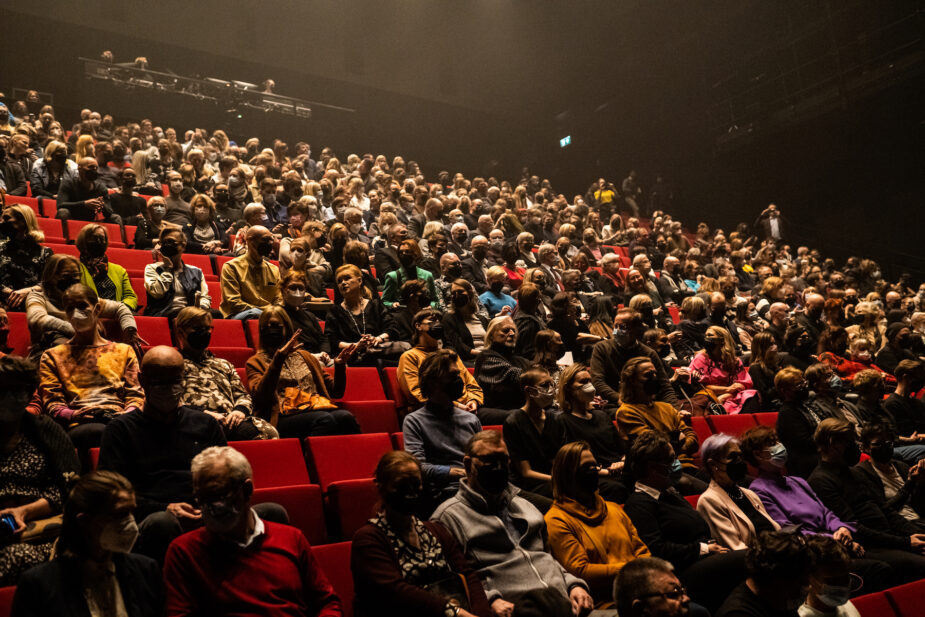
Helsinki finally got a venue with a large stage dedicated to dance: Tanssin talo, Dance House Helsinki. What kinds of new opportunities will the 700-seat hall bring to the field of dance, and what sorts of challenges could a large venue create for contemporary dance artists and program planners? How can they reach large and diverse audiences? Award-winning dance artist and music maker Elina Pirinen’s new piece Mortal Tropical Dances will be performed in Tanssin talo 5 – 14 May.
Text: Sanna Kangasluoma Translation: Lola Rogers | The article was originally published in Finnish Dance in Focus 2023 magazine .
Focus magazine asked dance artist Frédérick Gravel and Virve Sutinen—who has, among other roles, served as artistic director of the Tanz im August festival—for their views on what is most essential when talking about large venues, what to expect from them, and how to make them work.
Frédérick Gravel: The audience has the biggest part in the show
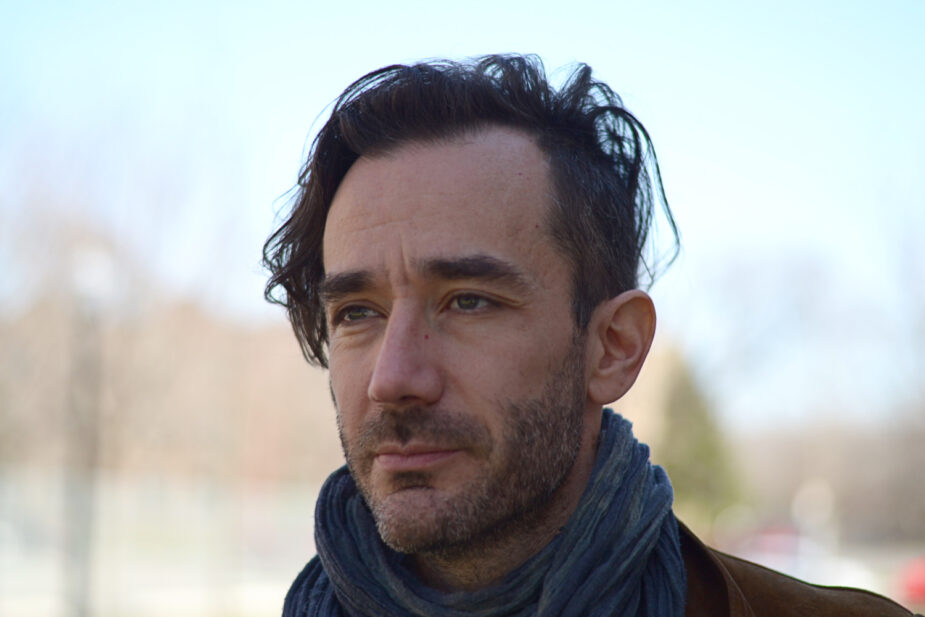
Canadian dance artist and choreographer Frédérick Gravel has experience creating work and performing in many different arenas. For him, the audience is key.
“The smaller venues where we tour are often focused on dance, and there we meet a kind of a specialized audience, who may see from five to twenty contemporary performances a year.
When there is a smaller audience, you, as an audience member, will hold a bit more responsibility – it’s a different kind of attention. In a bigger space, you are part of something different,” explains Gravel.
Gravel has a strong sense of the audience’s energy that is conveyed to the performers. “When it’s a full house in a big venue, half of the show is already done in so many ways! Having organized it, getting all those people in, and then it’s already happening… You feel this expectation, the energy from hundreds of people.”
Gravel considers the effect of a large, heterogenous audience’s reception of a performance.
“When you are surrounded by a lot of people, then you see the piece with multiple eyes, you see things differently. You imagine more minds seeing the show than when you are in a smaller space – and more people means a multiplication of perspectives.”
Gravel believes that creating a piece for a large venue is an opportunity, and all you have to do is make it work. There’s no need to feel afraid of a large audience and a large stage.
“Sometimes it’s even easier – when you play in a big space, the technical resources are wonderful, the sound is good, it looks nice, and lots of things are easier. But to make the work relevant—that’s not that easy,” he says, musing on his own practice, which is based on somatic research.
The other side of the coin is the fact that a big, fancy space can take over and influence the form of a piece more than you intend it to.
“Space is always formalizing. If there are more technical elements, that means a larger crew, and the show is more rigid. Then you have to find out how to pervert the formalization – that’s really satisfying when it happens, but it’s not that easy,” he points out, explaining that the by “pervert” he means “do something you’re not supposed to do”.
Whether on a small or large stage, art means taking risks.
“I like the work to be more risky than rigid. That’s a challenge in big spaces because what’s on stage has to be happening for real. If there is no vulnerability and risk in the work, I think we are wasting our time.”
Virve Sutinen: The role of large venues in establishing a contemporary dance culture can’t be overlooked
Virve Sutinen, whose varied roles include leading Stockholm’s Dansens Hus and serving as artistic director for the Tanz im August festival in Berlin, sees large venues as an important factor in creating and maintaining the whole culture of watching dance.
“Dance culture should have a place for both small and large spaces and stages. If and when you want to approach a ‘large audience’, you have to also think about the social conventions associated with theater-going that those attending performances at large venues may already be familiar with. Not just the performance but also the experience as a whole is important—what happens before the performance and during the intermission, what sorts of services are available,” Sutinen says.
“Personally, I enjoy having a lot of people around me. It’s a different feeling of community than in an intimate space. On a large stage it’s also simply easier to grow your audience and achieve the kind of visibility and importance that will, ideally, promote the development of the whole field of dance.”

“The importance given to dance is influenced by everything built around dance in our society, everything that supports the entire field—the media, publicity and criticism, information centers, schools, dance venues and theaters, everything that serves to maintain dance culture as a whole. All of it requires funding and resources, mechanisms of some kind that can assure continuity and make long-term work possible,” says Sutinen.
“The importance of institutions—which large venues invariably are—is clear in the way they’re capable of appreciating and communicating artistic work and making it visible in a way that gets an audience to come out.”
It is difficult for the freelance field, where the vast majority of dance productions are created, to maintain and support the whole field of dance, because it doesn’t have the same kind of funding, influence, and permanence that institutions have. “Creating a culture of watching contemporary dance, building a relationship with the audience, can’t all be left to freelance artists,” Sutinen emphasizes.
She calls for continuous development work from large venues. Artists who have worked in smaller arenas and have the potential to grow into larger productions need support in many ways, on many levels, including in areas external to the arts.
“There are no magic tricks. All processes of development are long and take years—five to ten years, easily. Building and maintaining a relationship with the audience is central for the dance industry, and the larger the audiences we dream of, the more important it is to remember that the audience is our most important partner and defender at times when that is needed.”
Large venues have to do the work of development so that they remain relevant and interesting from the audience’s point of view.
“It would be great if the audience learned to expect something new, surprising, and wonderful even in large venues. Too often, the large stages play it safe, which leads to a narrower artistic output. There is diversity to be found in dance, new creators and new points of view that can be drawn on to widen the audience,” Sutinen suggests.
“There are many transnational projects happening in Europe aimed at increasing the diversity in dance,” she says. “One of these is Big Pulse Dance Alliance, which supports new choreographers’ efforts to develop their skills in creating a larger production or dance organization. I hope that in future this will be visible in more artists from a variety of backgrounds and styles appearing in large venues. There is a need for openness and courage about what is thought to be of value in dance. It could be anything from dance theater to experimental dance and it could happen on both large and small stages, or off them.”
Canadian Frédérick Gravel also yearns for new audiences. He worries about the current inequality at larger venues—young people feel that they are not the target audience because the ticket prices are out of their reach. The accessibility of larger stages needs to improve because, at their best, they can be places for demonstrating the idea of multiple meanings in art.
“The best, achievable goal would be that the art is the thing getting different kinds of people together in one experience. Because it’s ok to not see it the same way – art is meant to be seen differently: you liked it but the one next to you didn’t. That’s perfect. It’s meant to be like that.”
—
Elina Pirinen’s long-awaited new symphonic creation Mortal Tropical Dances will fill the large stage of Dance House Helsinki 5 – 14 May, with special dances arising from our inner tropics, wild live music, mesmerising colours and scents. The work is part of Tanssin talo’s SPARK project.
Further information
Dance House Helsinki has two stages and four permanent program partners—Cirko Center for New Circus, Dance Theatre Hurjaruuth, Tero Saarinen Company, and Zodiak Center for New Dance—who each produce their own program season. The venue also has visiting performers and stage rentals.
SPARKS is a Dance House Helsinki project in which selected dance artists receive support and assistance in developing and producing new works for both the large and small stage. Artists Milla Koistinen (Magenta Haze, fall 2022), Johanna Nuutinen (fall 2023), and Elina Pirinen (spring 2023) will have upcoming premieres on the large stage. Outi Markkula (Kulkue-Parad–Parade, fall 2022), Mikko Hyvönen (fall 2023), and Marika Peura & Kaisa Nieminen (spring 2023) will make their premieres in the smaller, 235-seat Pannuhalli stage.